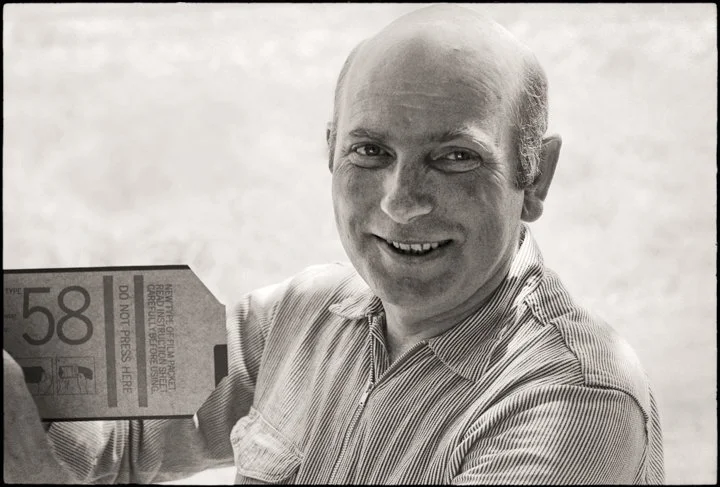
Al Weber, teaching in Yosemite at the Ansel Adams Workshop, 1970
Al Weber
In the Spring of 1969, having recently fallen in love with photography, I enrolled in the upcoming Ansel Adams Summer Workshop in Yosemite. In the run-up to the summer I acquired and studied Adams’ Basic Photo Series. I had to be honest with myself and admit that while the books were illuminating in many ways, I really didn’t understand Book #2: The Negative. Exposing the film, which I had thought was a pretty straightforward thing: point the camera, center the needle, click the shutter; turned out to be be a bit more complicated. Studying Adams’ approach to exposing and developing film, otherwise known as The Zone System, was as opaque to me as my high school French had been.
But I was heading to Yosemite, and felt sure that getting the explanation from the horse’s mouth, so to speak, would remedy my confusion. To the contrary, Adams’ introductory Zone System lecture left me more befuddled than before. He might as well have delivered that lecture in French.
The next day was our first day in the field, at Mirror Lake. Not only was I struggling with my deepening exposure confusion, but also with my recently acquired 4x5 view camera. I was set up at the edge of Tenaya Creek, just below the outlet of the Lake, trying to figure out how to get the depth of field I needed. I suspected that those “swings and tilts” held the solution. But it seemed like the more I tilted, the more everything got out of focus. I was pretty much paralyzed. I found myself thinking, “What am I doing here? I am in way over my head!”
A minute later, emerging from under the focusing cloth no closer to a solution, one of the other workshop instructors was standing next to me. It was Al Weber. Maybe he had sensed that I was having trouble, or perhaps he was just “making the rounds”. He asked how I was doing. I was tempted to say that I was considering tipping my tripod over into the creek and going home, but I didn’t. I tried to articulate the problems I was having: first, how to get the damn view camera to cooperate, and second, assuming I made progress there, how to figure out the exposure using Ansel’s mystifying Zone System.
It took Al about two minutes to calm me down and to get me well on my way to solving my camera issues. “You just need a small amount of front tilt to get the depth of field you want here,” he told me. “And you need to slightly refocus back and forth as you’re tilting.” He then gave me a short exposure lesson, translating the important parts of Ansel’s lecture into plain English. Thanks to Al’s help in that moment I learned that while Adams was certainly the “draw” at the Yosemite Workshop, it was the other instructors who could provide personal attention and be sure the students “got it”. It was my good fortune that it was Al who appeared in that moment. In the 55 years since that day I have yet to meet a more effective instructor.
Over the following few years I became close friends with Al; a friendship that lasted for the rest of his life. I assisted at several of his workshops that he ran with Pirkle Jones, Ralph Putzker, and Glenn Wessels at Bixby Creek and Death Valley. It’s impossible to quantify how much I learned from those experiences. It wasn’t just the technical “photo stuff”. The most important things I absorbed from Al and the others in those years was an attitude toward making photographs, and how expressing a personal sensibility was even more important than the photographs themselves. This knowledge wasn’t imparted through spoken lessons, but rather through osmosis in watching how they lived their lives and how that fed into the Art that they made. Al would probably bristle at my using the word “Art” in that context, but that’s okay. He often did his most effective teaching in reaction to something that annoyed him.
I was one of the few individuals among his photography friends/students who was also a football fan. I would often call Al on autumn Mondays to discuss the weekend’s college and pro games. I once commented to him that I was surprised that he held his annual Rendezvous on an October weekend, since that is the heart of the football season. “I know,” he replied. “It surprises me too!”
In 1970 one of Al’s sons was seriously ill and was being treated at the University of California Hospital in San Francisco. My family home, where I was still living at the time, was two blocks from the hospital. My folks and I asked Al to be our guest so he could be close by. Many times when Al returned from the hospital my mother was the only one at home, and the support she gave him during the emotional trauma of his son’s illness created a strong bond between them, bordering on devotion on Al’s part. Decades later, at a Rendezvous at Songdog Ranch, many of the photographers, while presenting their work, spoke about how Al’s critiques, while ultimately beneficial, could be brutal and agonizing to bear. When it was my turn to present, I had to confess to the group that I had never been on the receiving end of one of Al’s torturous critiques, and that I believed I knew why: that word of it might get back to my mom, and she would be mad at him. From his perch at the back of the room Al bellowed out, “You’ve got that right!”
It was always a good feeling when Al told me that I got something right.
This essay was written in 2024 for a memorial book dedicated to Al, created by friends, family, and his legion of former students.